
AI Chatbots for Small Business: Complete 2026 Guide for UK SMEs
AI Chatbots for Small Business: Complete 2026 Guide for UK SMEs
If you’re a UK small business owner struggling with high customer inquiry volume and losing leads after hours, you’re not alone. Modern AI chatbots for small business are now smart, essential assistants that help UK SMEs thrive.
This guide provides actionable insights on how small businesses can use chatbots affordably, covering implementation and showing how you can leverage low cost chatbot solutions for small businesses without needing a large budget.
What Are AI Chatbots for Small Business?
At their core, chatbots for small business are automated tools engaging website visitors and app users via chat interfaces. Modern small business chatbots, powered by AI like ChatGPT-5, have evolved past simple scripts; they can now grasp context, handle complex inquiries, and participate in genuinely helpful conversations.
How Small Business Chatbots Work
Imagine an AI chatbot as your dedicated team member, always on the clock and managing multiple conversations.
- Natural Language Processing (NLP) enables the small business chatbot to understand the customer’s real question, even if phrased differently. It recognizes intent to provide the correct answer instantly.
- Machine Learning ensures the chatbot improves over time, learning optimal responses to fit your unique business needs.
- Integration Capabilities allow your ai chatbot for small business to connect to existing tools, like accessing your calendar to book appointments or adding leads to your CRM.
For UK small businesses, a fully managed service handles these technical complexities, allowing you to reap the rewards without needing expertise.
Why UK Small Businesses Are Adopting AI Chatbots?
The adoption of AI chatbots for small business among UK SMEs is accelerating, partly due to businesses seeing a 67% average sales boost. This trend is driven by customer expectations for quick, instant answers, even late at night.
The adoption of AI chatbots for small business among UK SMEs is accelerating, partly due to businesses seeing a 67% average sales boost. This trend is driven by customer expectations for quick, instant answers, even late at night.
A small business chatbot offers immediate engagement, preventing leads from going to competitors. For UK SMEs, a chatbot allows them to level the playing field against larger companies by managing the workload of a full team at a fraction of the staffing cost.
Managed vs DIY Chatbot Solutions
Choosing between DIY and managed services is a critical decision for low-cost chatbot solutions for small businesses. DIY platforms offer control, but creating an effective bot demands over 20 hours a month for writing flows, testing, and optimization—a high time commitment for owners.
Regardless if you are a plumber, electrician or an accountant a managed services handles everything, including setup, training, content, integrations, and continuous optimization. This is the ideal best chatbot to save time for small businesses. For UK SMEs, considering opportunity cost, managed services are often more cost-effective.

The Business Benefits of AI Chatbots for Small Businesses
Understanding what chatbots can do is one thing, but grasping how they can impact your bottom line is what truly counts. Let’s dive into the tangible business advantages that make AI chatbots a top-notch investment for small businesses in the UK.
Reduce Support Costs by Up to 67%
Hiring a UK customer service rep costs £20,000-£25,000 annually. In contrast, a small business chatbot to reduce support costs starts at just £99 a month (£1,188 annually)—approximately 95% cheaper, and it works 24/7.
Beyond replacement, small business chatbots boost efficiency by automating repetitive inquiries (60-70% of questions) like “What are your prices?” This frees up your human team to focus only on complex, valuable interactions. A business example showed a 68% reduction in customer service workload, saving the owner 17.5 hours per week.
Generate More Leads on Autopilot
When a potential customer visits your site outside of business hours, an AI chatbot for small business captures the lead instantly. It engages the visitor, answers questions in real-time, and collects contact information—all while you are away.
Statistics show chatbots for small business convert an average of 28% of visitors into qualified leads, compared to 2-5% for contact forms. More importantly, the chatbot qualifies leads by gathering details on budget and need, ensuring you only spend time on genuine prospects. The 24/7 availability captures 40-50% of leads that would otherwise be lost outside traditional business hours.
Save Time with Automated Customer Service
Time spent repeatedly answering the same questions is time lost from strategic growth. This is where the best chatbot to save time for small businesses proves its worth by eliminating constant interruptions.
The small business chatbot handles all routine inquiries instantly and accurately, allowing owners to maintain uninterrupted focus on high-value work. UK small businesses report saving an average of 15–20 hours per week with AI chatbots—gaining over 800 hours per year. These savings extend beyond Q&A to automating scheduling, lead qualification, and information dissemination.
Improve Customer Satisfaction
Waiting hours for a response is unacceptable in 2026. Small business chatbots deliver immediate responses, driving satisfaction, as 82% of customers expect instant answers.
Beyond speed, chatbots for small business ensure perfect consistency. Unlike human agents, the chatbot delivers accurate information (pricing, policies) the same way every time, building trust. The always-on availability improves satisfaction by offering reliable help at any hour, day or night.
Scale Without Scaling Costs
Traditional customer service scales linearly, making success more expensive. AI chatbots for small business break this pattern. Your affordable chatbot for small businesses handles 10 or 1,000 conversations equally well, scaling automatically without added cost.
A single chatbot manages surge periods (product launches, seasonal peaks) effortlessly. This allows UK small businesses to confidently scale marketing, knowing initial inquiries will be handled professionally and consistently regardless of volume.
How Much Do Small Business Chatbots Cost?
Cost is naturally a primary concern for UK SMEs considering chatbots. The good news is that chatbots for small business price points have become remarkably affordable, making this technology accessible to virtually any business. Let’s break down exactly what you can expect to invest.
Understanding Chatbot Pricing Models
Cost is naturally a primary concern for UK SMEs considering chatbots. The good news is that chatbots for small business price points have become remarkably affordable, making this technology accessible to virtually any business. Let’s break down exactly what you can expect to invest.
Understanding Chatbot Pricing Models
Understanding chatbots for small business price is crucial. The most common model is Monthly Subscription Pricing—a fixed fee covering setup, hosting, and message volume, which is predictable for small business budgeting.
Alternatively, Per-message Pricing can lead to unpredictable costs as traffic increases. Watch out for hidden costs like fees for extra integrations, team members, or message limit overages. The best value is straightforward monthly pricing with clear inclusions and reasonable setup fees.
Low-Cost Chatbot Solutions for Small Businesses
The market now offers genuinely accessible low-cost chatbot solutions for small businesses.
- Entry-level managed services start around £99 per month. This provides essential features like website chat, lead capture, FAQ handling, and ongoing monitoring.
- Mid-tier packages (around £129-£149/month) add sophisticated features, including complex flows and priority support for growing businesses.
The key to how to get an affordable chatbot for a small business is choosing managed services that bundle setup, training, and optimization into a single monthly fee, avoiding separate component costs.
How small businesses such as roofers, bathroom fitters and landscapers can use chatbots affordably is by recognizing that managed services include everything: professional development, all technical integrations, comprehensive content creation, and continuous optimization. You gain better results because you buy outcomes, not just software, making it a truly low cost chatbot solution for small businesses.
Why Managed Chatbot Services Offer Better Value
At first glance, DIY chatbot platforms might seem more affordable. “Why pay £99/month when I can use Platform X for £49/month?” But this comparison misses the total cost picture.
DIY platforms require your time and expertise:
- Building conversation flows: 10 hours initially
- Creating comprehensive FAQs: 10 hours
- Setting up integrations: 2 hours per integration
- Testing and refinement: 10-15 hours
- Ongoing optimization: 2-3 hours monthly
That’s 30+ hours upfront and 3-5 hours monthly ongoing. At even £25/hour for your time, the DIY approach costs £750 to £1,000 initially plus £75 monthly—making it more expensive than managed services while delivering inferior results since you’re not a chatbot specialist.
Managed services include:
- Professional chatbot development by experts
- Comprehensive FAQ and content creation
- All technical integrations handled
- Thorough testing before launch
- Continuous monitoring and optimization
- Support when you need it
- Updates and improvements over time
How small businesses can use chatbots affordably is by recognizing that fully managed services actually represent better value when you factor in time, expertise, and results quality. You’re not just buying software; you’re buying outcomes.

How Small Businesses Can Use Chatbots Affordably
Understanding pricing is one thing, but maximizing value from your investment requires a strategic approach. Here’s how to implement low-cost chatbot solutions for small businesses while achieving excellent results.
Starting Small: Essential Chatbot Features Only
To achieve low cost chatbot solutions for small businesses, avoid “analysis paralysis” by not trying to build the perfect chatbot immediately. Instead, focus on 1-2 highest-impact use cases: appointment scheduling for service businesses, or lead qualification for professional services.
Every small business chatbot needs these core features:
- Website engagement and FAQ handling
- Lead capture (including qualifying questions)
- Human handoff and basic integration (CRM/email)
Start with these essentials to gain immediate value, then expand capabilities once core value is proven.
Choosing the Right Package for Your Business Size
Right-sizing your investment ensures maximum value. Starting with how to get an affordable chatbot for a small business means matching the solution to your present reality:
- Micro Businesses (£99-£129/month): Need starter core functionality (chat, lead capture, FAQ) and one key integration.
- Small Businesses (£129-£149/month): Benefit from growth packages with multiple integrations and sophisticated flows.
- Growing Businesses (£149-£199/month): Require pro packages with advanced features and priority support.
Be honest about current needs; you can always upgrade. This ensures your chatbots for small business investment is optimized from day one.

Maximizing Value from Your Chatbot Investment
Maximizing ROI requires actively optimizing your small business chatbot over time. The best chatbot to save time for small businesses from locksmiths to pest-control services our managed chatbot is consistently refined, not set and forgotten.
Best Practices for Success:
- Promote Actively: In the first weeks, ensure customers know the chatbot exists via newsletters and social media.
- Review Conversations: Monthly review of conversation logs identifies areas for improvement and new FAQ needs.
- Refine & Expand: Work with your managed provider to optimize conversion paths and add capabilities based on usage data
- Track Metrics: Monitor volume, lead generation, and conversion rates regularly.
Common Mistakes to Avoid:
- Setting and Forgetting: Lack of optimization wastes potential.
- Poor Integration: Ensure leads flow directly into your sales process, not unmonitored inboxes.
- Trying to do Too Much: Start focused and expand only after core value is proven.
AI Chatbot Technology for Small Businesses
Understanding the technology behind your chatbot helps you appreciate what’s possible and make informed decisions. But don’t worry—you don’t need to become a technical expert, especially with managed services handling implementation.
ChatGPT-5 and Natural Language Processing
The leap to AI-powered systems like ChatGPT-5 is remarkable. Older chatbots used rigid, rules-based systems, failing if phrasing varied.
Modern Natural Language Processing (NLP) allows AI chatbots for small business to understand customer intent regardless of phrasing. For example, it recognizes “What’s your price?” and “How much does it cost?” as the same question.
The system also offers:
- Context Awareness: Remembering earlier conversation points.
- Nuance Understanding: Handling complex or contradictory requests, leading to genuinely helpful, non-rigid responses for UK SMEs.
Lead Capture and Qualification
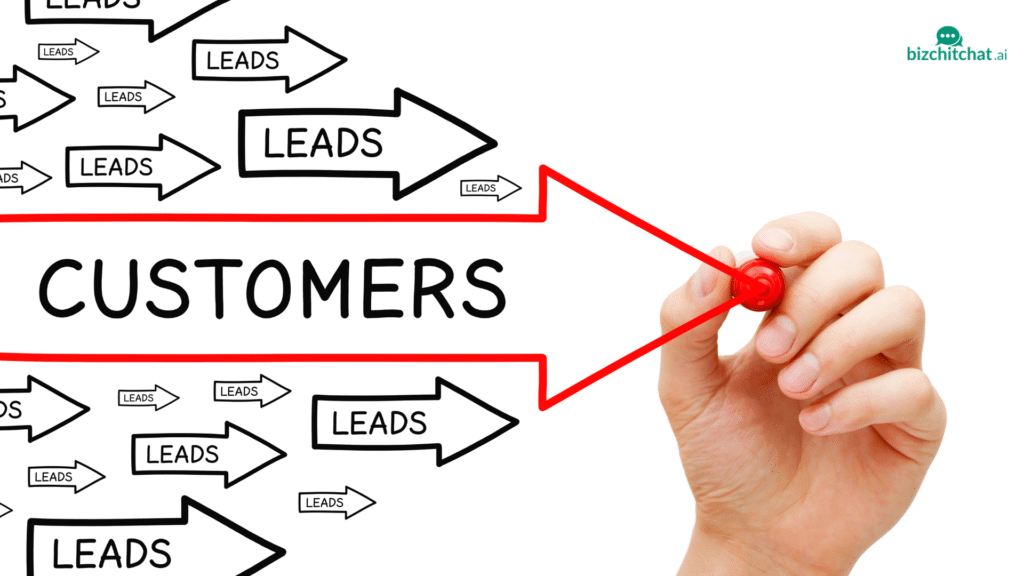
The power of AI chatbots for lead generation lies in intelligent qualification. Not all visitors are equal; some are ready to buy, others are just browsing.
- Progressive Profiling: Chatbots collect information conversationally instead of using intimidating forms.
- Intent Signals: High-intent leads (asking about pricing, timelines) are flagged for immediate follow-up.
- Qualification Routing: Ensures leads reach the correct staff member (e.g., technical questions to technical staff).
- Smart Lead Scoring: Assigns value based on responses and behavior.
This results in your sales team spending time only on qualified, high-potential prospects, making small business chatbots highly efficient.
Integrations That Matter for Small Businesses
An isolated chatbot that doesn’t connect to your other systems creates busywork. Powerful chatbots for small business integrate seamlessly with your existing tools, creating automated workflows that save time and ensure nothing falls through cracks.
WhatsApp Business integration brings your chatbot to where many customers prefer to communicate. In the UK, WhatsApp is ubiquitous for business communication. Integrating your chatbot means people can inquire via WhatsApp and receive intelligent, automated responses while you handle only conversations requiring human touch.
- CRM connectivity automatically logs every chatbot conversation to your CRM system. Contact information, conversation history, qualification details—everything flows automatically into your existing customer database. This creates a complete picture of every prospect’s journey without manual data entry.
- Email and SMS notifications keep you informed about important interactions. When a high-value lead engages with your chatbot or someone requests urgent contact, automated notifications ensure immediate follow-up.
- Calendar integration allows chatbots to book appointments directly. Someone wanting to schedule a consultation sees your available times, selects a slot, and receives confirmation—all without your involvement.
- Google Sheets provides a simple but effective solution for businesses not using formal CRM systems. Every lead flows into a spreadsheet automatically, creating an organized record you can review and action.
- Payment processing enables chatbots to collect deposits or full payment for bookings, consultations, or products. This is particularly powerful for service businesses where securing payment upfront reduces no-shows.
For affordable chatbot for small businesses, integrations are what transform a nice-to-have tool into an essential business system. Managed services handle all technical integration work, typically asking you for credentials and configuring everything on your behalf.
Human Handoff When Needed
Even the best AI chatbot for small business UK needs human expertise sometimes. The key is graceful transition:
- Intelligent Escalation: Triggers (like frustration detection or specific phrases) determine when handoff occurs.
- Context Transfer: The human agent receives the full chat history, avoiding the need for the customer to repeat information.
- Business Hours Awareness: Manages customer expectations based on staff availability.
This hybrid approach combines AI automation with strategic human involvement for complex or sensitive interactions, ensuring optimal customer experience.
Implementation Considerations for Small Businesses
Moving from considering chatbots to actually implementing one involves several practical considerations. With fully managed services, these are straightforward, but understanding the process helps set realistic expectations.
How Long Does Chatbot Setup Take?
Implementation time varies greatly. DIY approaches typically take 2 to 4 weeks for small business chatbots, as owners must fit training, building, and testing around their core responsibilities.
Managed services are much faster (2-5 days):
- Days 1: Initial consultation and requirements gathering.
- Days 2: Provider develops flows, content, and integrations.
- Days 3-4: Client review/testing, followed by refinement.
- Day 5: Launch.
Chatbots for small business UK are live in about two weeks with minimal time investment from the owner.
Content Requirements: What Your Chatbot Needs to Know
Many small business owners worry that limited website content or lack of written FAQs are obstacles. With managed services, they are not.
Chatbots need to know: Core products, pricing, service areas, policies, and common customer questions.
Where this information comes from:
- Your Website: Managed services extract and rewrite existing content into conversation-friendly formats.
- Consultation: Your knowledge of common customer questions during setup becomes the core chatbot FAQs.
- Provider Expertise: Professionals create and supplement necessary content, even using competitor research to anticipate questions.
If your website is sparse, the provider creates the necessary training content through consultation, improving both your chatbot and your site. For UK small businesses, managed services make content requirements a non-issue.
Customizing Your Chatbot’s Personality
Your small business chatbot should sound like your brand, not like a generic robot. Personality customization ensures your chatbot feels like a natural extension of your team.
Tone options:
- Professional and formal (solicitors, financial advisors, medical practices)
- Friendly and approachable (retail, hospitality, consumer services)
- Casual and playful (creative industries, young brands)
- Helpful and informative (technical services, education)
UK-specific language considerations:
- British English spelling and terminology (not “color” and “center”)
- Local references and cultural awareness
- Regional considerations if you serve specific areas
- Appropriate formality for British business culture
Brand voice alignment:
- Does your brand use first person (“I can help”) or third person (“Our team can help”)?
- Are contractions acceptable (“We’ll help”) or should language be more formal (“We will help”)?
- What words and phrases are very “you” versus completely off-brand?
- Should the chatbot use humor or stay strictly informational?
Name and persona: Some businesses give chatbots names and personas (“Hi, I’m Sarah, the [Company] assistant”). Others keep them anonymous (“Welcome to [Company]! I can help with your questions”). Neither is inherently better; it depends on your brand personality.
Managed services walk you through personality decisions during setup, often providing examples of different approaches so you can identify what feels right for your brand. The result is a chatbot that sounds authentically like your business rather than obviously automated.
Testing and Quality Assurance
Your small business chatbot must sound like your brand, not a generic robot. Personality customization ensures it feels like an authentic team extension.
Key Customization Considerations:
- Tone: Choose the right tone for your industry (e.g., formal for financial, friendly for retail).
- UK-Specific Language: Ensure British English spelling and terminology are used.
- Brand Voice: Align the chatbot’s use of pronouns, formality, and acceptance of contractions with your existing marketing voice.
- Persona: Decide whether to give the bot a name and specific persona or keep it anonymous.
Managed services guide you through these decisions, ensuring the final chatbot sounds authentically like your business rather than obviously automated, a crucial feature for AI chatbots for small business.
Choosing the Best Chatbot
With numerous options available, selecting the right chatbot solution requires evaluating several factors against your specific needs and circumstances.
Managed vs Self-Service Platforms
This decision fundamentally shapes your experience.
Self-Service Platforms (DIY) suit businesses with:
- Technical team members available for building and optimizing.
- Simple use cases (basic FAQs only).
- Willingness to invest 20+ hours upfront plus ongoing maintenance.
- Managed Services handle everything for you. They suit businesses with:
- Limited technical expertise or interest.
- Complex needs (integrations, qualification flows).
- Preference to focus on the business rather than chatbot management.
For most UK SMEs, managed services are more cost-effective. The best chatbot to save time for small businesses is one that doesn’t consume your time to build and manage, making professional management the logical choice for the time-constrained business owners.
Essential Features Checklist
When evaluating chatbot options, ensure they include these fundamental capabilities:
Must-have features:
- Natural language processing (understanding varied question phrasing)
- Lead capture and qualification
- CRM or database integration
- Human handoff for complex queries
- Mobile-responsive interface
- Basic analytics and reporting
- Website integration
- GDPR compliance for UK businesses
Important features for most businesses:
- WhatsApp Business integration
- Email notifications for urgent inquiries
- Appointment booking capability
- Multi-language support (if you serve non-English speakers)
- Conversation history and transcripts
- A/B testing capabilities for optimization
Nice-to-have advanced features:
- Outbound messaging capabilities
- Advanced workflow automation
- Multiple chatbot personalities for different purposes
- Voice integration
- Video response capabilities
- AI-generated images or documents
Start with must-haves and important features. Advanced capabilities can be added later as needs evolve. Many businesses over-specify requirements initially, paying for features they never use. Better to start focused and expand than over-invest upfront.

Questions to Ask Chatbot Providers
These questions help evaluate whether a provider genuinely fits your needs:
About service and support:
- What’s included in your monthly fee versus charged separately?
- How quickly will our chatbot be operational?
- What ongoing support do you provide?
- How do you handle updates and improvements?
- Can we see examples of chatbots you’ve built for similar businesses?
About capabilities:
- Which platforms and tools do you integrate with?
- Can you create content and FAQs for us?
- How do you handle situations when the chatbot can’t answer?
- Can the chatbot capture and qualify leads?
- How do you customize the chatbot’s personality for our brand?
About your business specifics:
- Do you work with UK small businesses regularly?
- Do you understand our industry’s typical inquiries?
- Can you provide references from similar businesses?
- How do you handle GDPR compliance?
- What happens if we need to cancel or change plans?
Red flags to watch for:
- Unclear about what’s included versus additional costs
- Cannot show relevant examples or case studies
- Pushy about long contracts (best services offer monthly flexibility)
- Vague about implementation timeline
- No clear process for customization or ongoing optimization
Quality providers answer all questions clearly, provide relevant examples, explain their process transparently, and demonstrate understanding of your business needs. They’re also honest about limitations rather than promising the moon.
Getting Started with Your Small Business Chatbot
Ready to move from consideration to action? Here’s your practical roadmap to implementation.
Step 1: Identify Your Primary Use Case
Before comparing options, clarify what you need most from your chatbot to ensure maximum value.
- Customer Service Automation: Priority is reducing time spent on repetitive questions. Focus on comprehensive FAQ coverage and excellent human handoff.
- Lead Generation: Priority is capturing qualified prospects. Focus on intelligent qualification, CRM integration, and after-hours availability.
- Appointment Booking: Priority is eliminating scheduling back-and-forth. Focus on calendar integration and confirmation workflows.
For all three, modern AI chatbots for small business can handle it, but ensure your provider understands all objectives. Identifying your use case takes 10 minutes but guarantees your
Step 2: Choose Your Package
Once you know what you need, selecting the right package becomes straightforward.
Starter Plan (£99/month) suits businesses that:
- Have straightforward needs (one primary use case)
- Operate in one primary channel (website or WhatsApp)
- Have 1-2 key integrations needed
- Are just beginning with chatbot automation
- Want to test the concept before expanding
Growth Plan (£129/month) suits businesses that:
- Need more sophisticated capabilities
- Operate across multiple channels
- Require 3-4 integrations
- Have growing conversation volume
- Want quarterly strategic reviews to maximize value
Pro Plan (£149/month) suits businesses that:
- Need comprehensive chatbot capabilities
- Operate across many channels
- Require numerous integrations
- Have high conversation volumes
- Want priority support and fastest response times
- Benefit from monthly content updates and optimization
Decision framework: If you’re uncertain between two tiers, start lower. Upgrading is easy when you’ve proven value and need expands. Starting too high means paying for unused capabilities.
All BizChitChat.ai packages include the core essentials: ChatGPT-5 AI, full setup, ongoing management, lead capture, and continuous optimization. You’re choosing the right scale for your current needs.
Step 3: Setup and Training (Done for You)
Managed services require minimal involvement from you, ensuring professional results. The total time investment from you is only 2–3 hours spread over two weeks.
The provider handles:
- Initial Consultation (1 hr): Gathering all business details, goals, and content needs.
- Content Development: Creating all FAQs and conversation flows based on consultation and industry expertise.
- Technical Setup: Configuring integrations (CRM, Calendar, etc.) and chatbot training.
- Testing & Launch: You provide 1–2 hours for review, and the team handles final refinement and deployment.
This contrasts sharply with DIY requiring 10 to 20 hours of your time. This is fundamentally how small businesses can use chatbots affordably while maintaining focus on their business, proving that managed services are the best chatbot to save time for small businesses.
Step 4: Launch and Optimize
Going live is exciting, but ongoing optimization transforms good chatbots into great ones, delivering compounding value.
- Launch Phase (Wk 1-2): Promote actively (emails, social media) and monitor initial conversations closely for quick fixes and wins.
- Early Optimization (Mo 1-3): Review logs weekly, identify new FAQ needs, and track key metrics (leads, time saved). Communicate patterns to your provider.
- Ongoing Refinement (Mo 3+): Monthly performance reviews and continuous capability expansion based on real usage data.
With managed services, the heavy lifting of optimization happens automatically; the team monitors and implements refinements. Your role is simply reviewing data, ensuring chatbots for small business become essential business systems.
Conclusion: Transform Your Small Business with AI Chatbots
The opportunity for UK small businesses to leverage AI chatbots is compelling. Technology that was once complex is now accessible through affordable, managed services.
The business case is clear: small business chatbots reduce support costs, generate qualified leads 24/7, save 15–20 hours weekly, and improve customer satisfaction. This levels the playing field against larger competitors by providing enterprise-level responsiveness on a small business budget.
Starting at £99/month, the investment delivers ROI often exceeding 1,000%. Crucially, managed services remove the complexity barrier. Professionals handle everything, allowing you to focus on growth.
Ready to Get Started?
If you’re ready to see how an AI chatbot can transform your UK small business, BizChitChat.ai offers AI call receptionist service designed specifically for SMEs. Starting at just £99/month, you get:
- ChatGPT-5 powered intelligence for natural, helpful conversations
- Complete setup and training handled professionally
- Ongoing management and optimization
- Key integrations including WhatsApp Business and your CRM
- Lead capture and qualification
- 24/7 customer service automation
- Continuous performance monitoring and improvement
No technical expertise required. No time-consuming setup. Just results.
Your small business chatbot to reduce support costs, generate more leads, and save hours every week can be operational within two weeks. The question isn’t whether chatbots work for small businesses—the evidence is overwhelming that they do. The question is simply how much longer you’ll operate without one while competitors gain advantages from this technology.
Take the next step: Visit our main chatbot page to explore packages, book a consultation to discuss your specific needs, or contact our team with any questions. Your fully managed, affordable chatbot solution is closer than you think.
The future of small business customer service is here, it’s accessible, and it’s delivering remarkable results for UK SMEs just like yours. The only question that remains is: when will you join them?